One Platform. Ready for More Missions.
Tell us what you need to capture and how
Schedule a demoTalk with a drone specialist
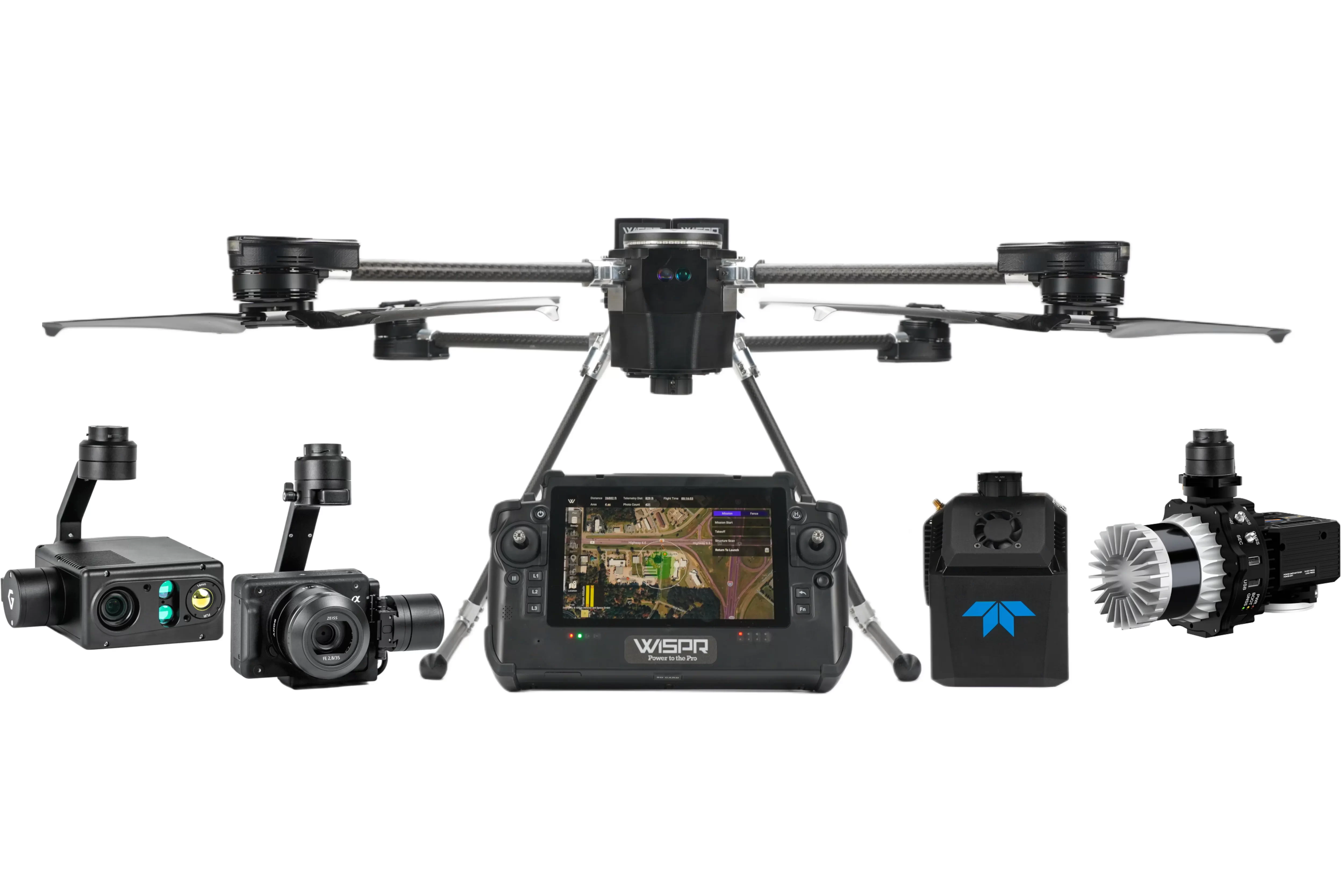 For many organizations, a drone is no longer a single-purpose tool. Surveyors, farmers, transportation departments, inspectors, engineers, and other professionals may need to collect very different types of data from one project to the next, even within the same day.
That is where modularity matters. A payload is the sensor or equipment a drone carries, such as a camera, a LiDAR unit, or a multispectral sensor, to collect a specific type of data.
The WISPR Systems SkyScout 2+ is an American-made, modular UAS designed to support multiple payloads and applications from one aircraft platform. Instead of purchasing and maintaining a separate drone for every type of job, operators can change payloads based on the data they need to collect and continue working with the same familiar system.
For organizations managing multiple projects, crews, and equipment budgets, that flexibility can have a direct impact on workflow, productivity, labor, and overall operating costs.
Different jobs require different payloads, but they do not always require different aircraft.
The SkyScout 2+ is built to support a range of professional payloads, allowing operators to change the sensor based on the work being performed. That means the aircraft can remain consistent while the mission changes.
For teams that work across multiple applications, this can simplify equipment planning and make it easier to adapt from one project to the next without changing platforms entirely.
A land surveyor may use high-resolution RGB imagery to create an orthomosaic or photogrammetric model, then switch to LiDAR for more detailed elevation or terrain data.
An agricultural operation may use RGB imagery for visual mapping and then move to a multispectral payload to evaluate crop health.
A Department of Transportation team may use LiDAR to assess terrain, drainage, or slope runoff while also capturing orthomosaic imagery for visual reference and inspection.
In each case, the type of data changes, but the aircraft platform does not.
That is the value of modularity: giving operators the ability to match the payload to the job without starting over with a completely different UAS.
The cost of a drone program goes beyond the initial aircraft purchase. Every additional platform can bring more batteries, chargers, spare parts, cases, maintenance requirements, software, training, and inventory to manage.
A modular platform can help reduce that duplication.
Instead of investing in separate aircraft for different applications, an organization can build around one platform and select compatible payloads based on the work being performed.
That can help reduce:
• Capital equipment costs
• Duplicate batteries, chargers, and accessories
• Training across multiple aircraft platforms
• Maintenance and spare-parts inventory
• Equipment transportation and storage
For teams managing tight budgets and multiple use cases, that can mean getting more value from one aircraft investment.
Modularity also benefits the people doing the work.
When operators stay on the same aircraft platform, they do not have to relearn a different flight system every time the application changes. Mission planning, setup, positioning workflows, batteries, and general operating procedures remain familiar while the payload changes to meet the needs of the job.
That consistency can reduce unnecessary steps in the field and help crews spend more time collecting data and less time managing equipment.
Productivity is not just about flight time. It is also about how quickly a team can deploy, complete a mission, change tasks, and move on to the next project.
The SkyScout 2+ is designed around efficient field workflows and adaptable payload integration, helping teams move between applications without completely resetting their equipment or processes.
For organizations managing several projects in a day, reducing setup time and equipment changes can add up to meaningful gains in productivity.
Using the right payload for the job can also improve both safety and data quality.
LiDAR can capture detailed three-dimensional information from terrain and infrastructure. High-resolution RGB imagery can provide visual documentation and photogrammetric data. Multispectral imaging can reveal crop and vegetation conditions that are not visible in standard imagery.
By collecting this information remotely, teams may be able to reduce repeat site visits or limit the need for personnel to physically access difficult or hazardous locations.
The result is a workflow that can help organizations use fewer resources while still collecting the accurate data needed to make informed decisions.
For organizations with varied workloads, modularity creates a more efficient way to build and manage a drone program.
Instead of investing in separate aircraft for different applications, teams can use the SkyScout 2+ as a consistent platform and change payloads based on the work at hand. That can help reduce equipment duplication, simplify training and maintenance, minimize downtime, and make better use of existing resources.
The result is a more flexible workflow that can support productivity, worker safety, data accuracy, and lower operating costs.
One American-made platform. Multiple payloads. More ways to work.
Explore the SkyScout 2+ and WISPR’s payload ecosystem to see how modularity can help your team accomplish more with one aircraft platform.
What is a drone payload? A drone payload is the sensor or equipment a drone carries to collect data, such as a high-resolution camera, a LiDAR unit, or a multispectral sensor. The payload determines what type of data the drone can capture on a given mission.
What types of payloads can a modular drone carry? Common drone payloads include RGB cameras for photogrammetry and orthomosaic imagery, LiDAR sensors for terrain and elevation data, and multispectral sensors for crop health and vegetation analysis. A modular platform like the SkyScout 2+ can switch between these payloads on the same aircraft.
What costs does a modular drone platform help reduce? Adding a payload to an existing modular aircraft avoids many of the costs that come with buying a separate drone for every application. Those costs include capital equipment costs, duplicate batteries, chargers, and accessories, training across multiple aircraft platforms, maintenance and spare-parts inventory, and equipment transportation and storage.